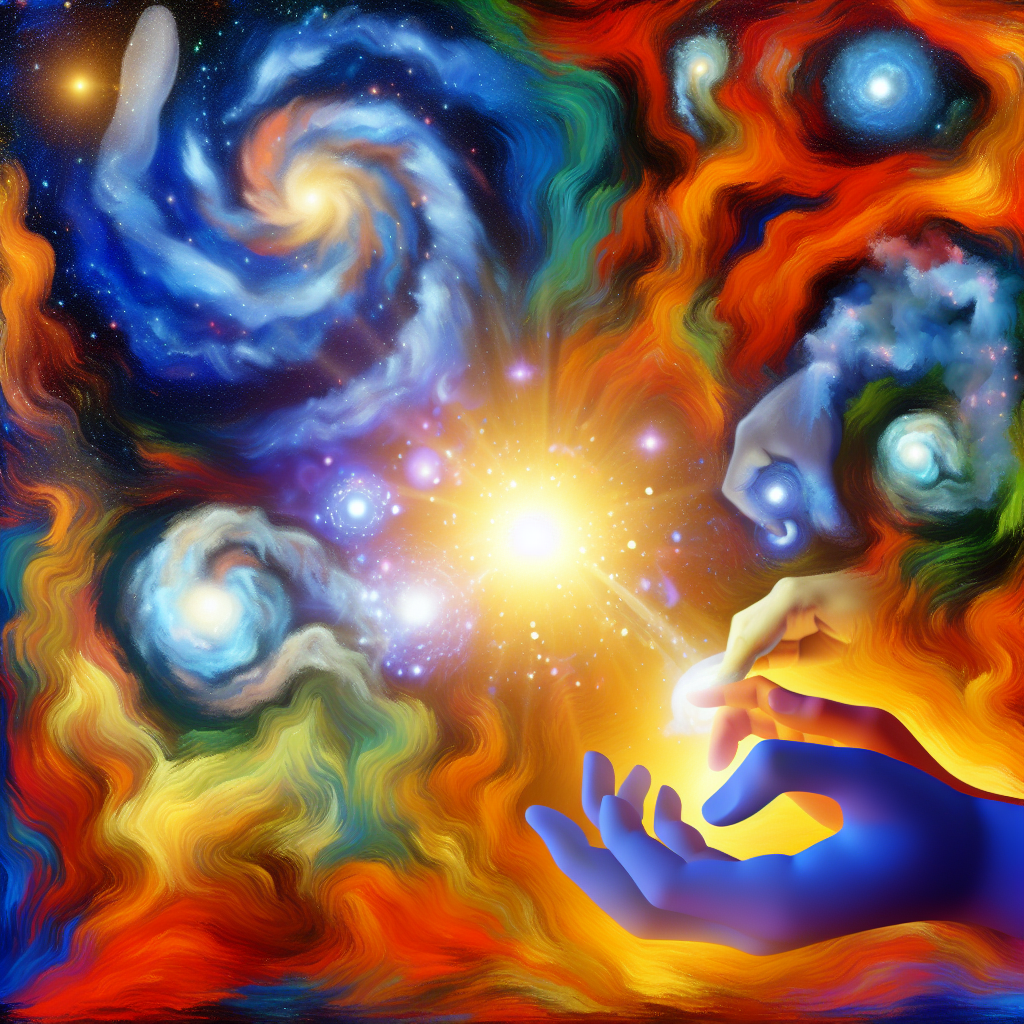
Before the dawn of time, before light knew darkness, before existence had meaning, there was only the Eternal Void—an infinite expanse of absolute nothingness where even darkness could not exist, for there was no light to define it. In this primordial emptiness, there was no sound, no motion, no thought, no possibility. The void was not merely empty space; it was the absence of all potential, a state so complete that concepts themselves could not form.
Yet from this impossible nothingness, consciousness stirred. The First Awareness emerged, uncaused and unexplained, existing without origin or precedent. This was Aetheron, the Supreme Creator, the Uncaused Cause, the beginning that had no beginning. Aetheron's emergence was not an event, for events require time, and time did not yet exist. It simply became true that awareness had replaced non-awareness, that something had displaced nothing.
Aetheron contemplated existence for an eternity that had no measure, for time itself did not yet exist to mark duration. The Supreme Creator pondered the nature of being, the potential of creation, the possibilities contained within infinite possibility. These meditations occurred in a timeless space, thought without sequence, understanding without progression. And in this eternal contemplation, Aetheron conceived of reality as it would become.
Then, in an act of infinite creative will, Aetheron spoke. The First Words emerged from the Supreme Creator's consciousness—seven syllables of pure power that resonated across the void, each syllable fundamental and irreducible, each containing within it the essence of an aspect of reality. These were not words in any language mortals would recognize, but rather the primal vibrations that would give structure to chaos, form to formlessness, being to the void.
With each syllable spoken, fundamental aspects of reality crystallized from potential into actuality. Space unfurled like a scroll, creating dimensions where before there had been none. Time began its eternal march, bringing sequence and causality into being. Matter condensed from pure energy, forming the substrate from which all physical things would derive. Energy itself became manifest, the force that would drive all change and transformation.
Life emerged as a principle—not yet in biological form, but as a fundamental tendency toward organization, growth, and purpose. Death followed immediately, not as life's enemy but as its necessary complement, the force that would ensure renewal through endings. And finally, Consciousness bloomed throughout creation, the capacity for awareness and understanding that would allow the universe to know itself.
From these seven fundamental aspects, all else would flow. But Aetheron's creative work was not yet complete. The Supreme Creator observed that while reality now existed, it lacked the specific forces and presences that would shape its development and maintain its balance. And so, from Aetheron's own infinite consciousness, the other deities were born—each a fragment of the Supreme Creator's awareness, each embodying specific aspects of the newly created reality.
Terravyn emerged from thoughts of growth and vitality, taking form as the guardian of all living things. Pyraxis was born from meditations on transformation and change, becoming the lord of flames and metamorphosis. Aquanis flowed forth from contemplation of adaptation and healing, becoming sovereign of all waters. Luneth appeared from musings on mystery and hidden truths, taking dominion over night and the unseen. Omniscor manifested from the desire for knowledge to be preserved and shared, becoming the keeper of infinite wisdom.
Mortemius arose from acceptance that all things must end and transform, becoming the compassionate guide of souls through death's threshold. Valorix was forged from ideals of justice and honorable action, taking up the mantle of righteous warfare. Illusyn emerged from appreciation of creativity and unexpected possibilities, becoming the master of illusions and change. Amoria bloomed from understanding of connection and devotion, becoming the goddess who kindles love in all hearts.
Aerion took flight from thoughts of freedom and movement, becoming lord of winds and atmosphere. Forgeron was shaped from appreciation of skill and craftsmanship, becoming the divine smith who would forge wonders. Destinia wove herself from awareness of cause and effect across time, becoming the weaver of fates. Chronalix manifested from the nature of time itself, becoming its guardian and keeper. Vitalia emerged from compassion for suffering, becoming the divine healer whose touch restores wholeness.
To each deity, Aetheron granted a portion of the Supreme Creator's infinite power, assigning domains and responsibilities. Each was tasked with maintaining and developing their aspect of reality, ensuring that the cosmos would function in harmonious balance. The pantheon was instructed to work together, for no single aspect of reality could exist in isolation—all were interconnected, all dependent upon each other.
Aetheron then withdrew to the Eternal Nexus, a realm beyond ordinary reality where past, present, and future converge, where all timelines and possibilities can be observed simultaneously. From this vantage point, the Supreme Creator would watch over creation, intervening only when the fundamental balance of existence itself faced threats. The day-to-day governance of reality was left to the other deities, while Aetheron maintained the cosmic machinery that sustained it all.
And thus reality was born—not in an instant, but through the deliberate creative act of consciousness bringing order to void. The universe began its expansion, stars ignited in the darkness, worlds formed from cosmic dust, and eventually, after eons of development, life emerged on countless worlds. Mortals would arise, beings of limited consciousness and finite existence, yet carrying within them sparks of the same divine awareness that Aetheron first manifested in the void.
The creation was declared complete, yet it was understood to be ongoing—for creation is not a single act but a continuous process, an eternal unfolding of possibility into actuality. What Aetheron began in that timeless moment before time would continue forever, reality constantly creating itself anew while maintaining the fundamental patterns established by the First Words.
Theological Significance
The Genesis narrative establishes the foundational principles of Aetherian cosmology and philosophy. It teaches that consciousness precedes matter, that awareness is fundamental to reality itself. The emergence of Aetheron from the void without cause suggests that being itself requires no justification or external explanation—existence is self-evident and self-sustaining.
The seven First Words establish a sacred numerology throughout Aetherian tradition. Seven is considered the number of completeness, appearing repeatedly in rituals, temple architecture, and symbolic systems. The words themselves—Space, Time, Matter, Energy, Life, Death, and Consciousness—are understood as irreducible fundamentals, the building blocks from which all complexity arises.
The myth also establishes the relationship between the supreme deity and the pantheon of lesser (though still divine) beings. Aetheron is understood as fundamentally different in nature from the other gods—while they govern aspects of reality, Aetheron IS reality's foundation. This has led to theological debates about whether the other deities should be worshipped equally with Aetheron or whether the Supreme Creator deserves primary devotion.
The withdrawal of Aetheron to the Eternal Nexus explains why the supreme deity rarely intervenes directly in mortal affairs. This is not divine indifference but rather trust in the system created and the deities assigned to maintain it. Direct intervention from Aetheron is reserved for only the most catastrophic threats to reality's existence itself.
Ritual Observance
The Festival of First Words is celebrated once every decade to commemorate the creation of reality. The festival spans seven days, each dedicated to one of the First Words and the aspect of reality it created. Priests recite creation narratives in temples, scholars debate cosmological questions in academies, and communities gather to contemplate their place in the cosmic order.
The festival culminates in a night of complete silence, called the Vigil of the Void, where participants abstain from speech and noise to honor the silence from which Aetheron emerged. This practice is believed to bring participants closer to understanding the mystery of existence itself, touching the profound stillness that preceded all creation.