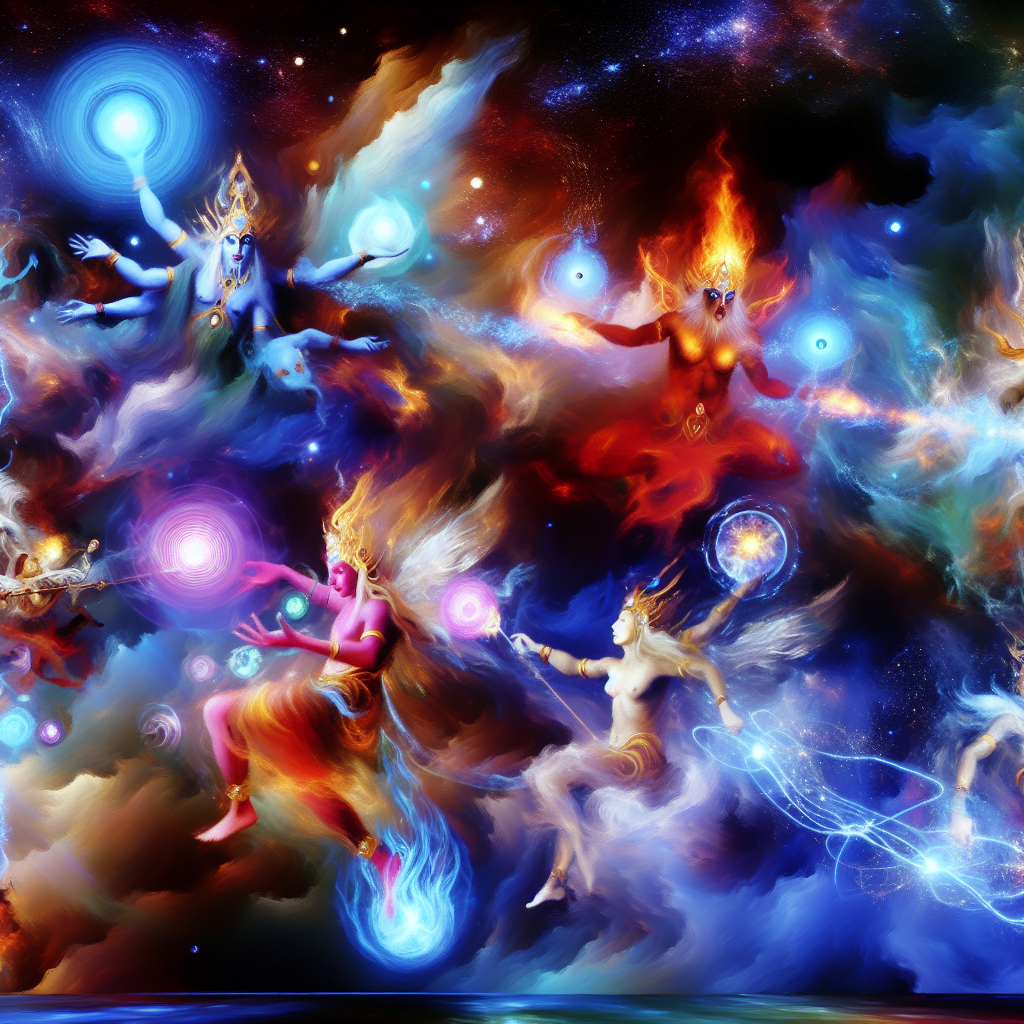
In the two thousand and three hundred forty-first year of the First Age, when mortal civilizations had spread across countless worlds and the divine order seemed secure, a tremor shook the foundations of reality itself. At the edges of existence, where the light of creation dimmed and the borders of the Eternal Void pressed against reality's fabric, something stirred in the darkness—something ancient, hungry, and filled with the desire to return all existence to the nothingness from which it had emerged.
The Void Titans were awakening. These beings had not been created but had emerged spontaneously from the Eternal Void itself, consciousness coalescing from pure negation. They were existence's antithesis, beings of entropy and dissolution whose very nature rejected the ordered reality Aetheron had established. Where the pantheon represented aspects of being, the Void Titans embodied non-being—the relentless pull toward the primordial nothingness that preceded creation.
The first sign came when stars began to vanish from the night sky, not dying in natural stellar death but simply ceasing to exist, swallowed by expanding regions of absolute void. Worlds on reality's fringes found their suns extinguished, their matter dissolving into nothingness. Mortals who approached these void regions reported a profound wrongness—a sensation of reality itself unraveling, of existence losing meaning and coherence.
Omniscor was the first deity to comprehend the threat's true magnitude. Consulting his infinite library, he discovered ancient records from the moments immediately after creation, texts he himself had forgotten writing. These chronicles described how, when Aetheron first spoke the First Words, the Eternal Void had resisted—fighting against the imposition of existence upon its perfect nothingness. That resistance had crystallized into the Void Titans, but they had been dormant, waiting, gathering strength over eons.
The pantheon convened in emergency session at the Hall of Convergence, the first time all fifteen deities had gathered since the earliest days of creation. Aetheron emerged from the Eternal Nexus, a rare occurrence that signaled the threat's existential nature. The Supreme Creator revealed that the Void Titans could not be destroyed—for how could one destroy pure negation?—but they could be contained, imprisoned, prevented from expanding their influence.
The war began at reality's boundaries and spread inward like a plague. Valorix led the martial aspect of the defense, commanding legions of valor spirits and mortal warriors brave enough to fight alongside gods. His lightning spear struck at the titans' manifestations, disrupting their form temporarily even when permanent damage proved impossible. Pyraxis unleashed transformative fire, forcing void-consumed regions to remember what existence felt like. Aquanis flooded void-touched areas with waters of healing, Terravyn rapidly regrew consumed ecosystems, and Forgeron forged weapons specifically designed to anchor reality against dissolution.
But the titans adapted and evolved, learning from each engagement. Where the gods brought unity and cooperation, the titans operated with the perfect coordination of beings sharing a single purpose: the complete negation of all that exists. They consumed divine energy, grew stronger from the gods' attacks, and seemed inexhaustible in their assault.
The turning point came in the war's forty-seventh year. Destinia perceived a crucial thread in the tapestry of fate—the titans were not truly conscious in the way living beings were. They were more akin to cosmic antibodies, automatic responses to what the Void perceived as contamination. They could not be reasoned with because they were not truly thinking; they were simply expressing the Void's inherent nature.
This insight led to a new strategy. Rather than fighting the titans directly, the pantheon worked to strengthen reality's foundations, making existence too robust for the titans to unmake. Chronalix stabilized time's flow, preventing the titans from creating pockets of temporal stagnation. Aetheron himself wove additional layers of reality into existence, creating redundancies so that if one aspect was consumed, others would support the structure.
Omniscor devised the Containment Theorem, a cosmic prison that would not destroy the titans but isolate them in specially constructed pocket realities where they could harmlessly consume themselves for eternity. This required unprecedented cooperation—all fifteen deities working in perfect synchronization, channeling their combined power into seven separate prisons, one for each titan.
The final confrontation occurred across multiple battlefields simultaneously. Valorix and Pyraxis engaged the titan of Dissolution in physical combat, buying time for Forgeron and Terravyn to construct its prison from materials that existed between states of being. Aquanis and Aerion worked together to trap the titan of Collapse in a bottle of infinite space where it could eternally contract without affecting true reality. Mortemius and Chronalix imprisoned the titan of Oblivion in a moment outside time, where it would experience neither existence nor non-existence.
The war's final day saw all seven prisons completed and sealed. The titans were not defeated in conventional terms—they remained as powerful as ever—but they were removed from reality's equations, unable to influence existence or spread their negation. Aetheron personally sealed the prisons' boundaries, ensuring they would hold until reality itself ended.
Victory came at tremendous cost. Entire galaxies had been consumed, countless mortal civilizations lost. Several minor deities who had fought alongside the fifteen had been partially unmade, reduced to shadows of their former power. The pantheon itself had expended energies that would take millennia to fully recover.
But the war established crucial precedents. It proved that the pantheon could function as a unified force when existence itself faced threats. It demonstrated that mortal courage could meaningfully contribute even in cosmic conflicts—many of the strategies that worked had been suggested by mortal tacticians fighting alongside gods. And it showed that Aetheron, despite withdrawing to allow the pantheon independence, would intervene personally when reality's existence was threatened.
The Celestial Conflict became the defining event of the First Age, a story retold across worlds and generations. Temples to all fifteen deities were built together rather than separately, acknowledging that divine unity had saved reality. The war's anniversary became a holy day when cooperation and mutual support were celebrated as the highest virtues.
Theological Significance
The Celestial Conflict fundamentally altered how mortals understood divinity and their relationship to cosmic forces. Before the war, gods had been viewed as essentially omnipotent beings who could accomplish anything through will alone. The war revealed divine limitations—there were threats even gods struggled to overcome, problems that required cooperation rather than individual power.
This made the divine more accessible in mortal understanding while simultaneously more respectable. If gods could face genuine challenges and work together to overcome them, mortals could learn from that example in facing their own struggles. The war's lesson was clear: unity in the face of existential threats transcends all other considerations.
The imprisonment rather than destruction of the Void Titans also established important theological principles about the nature of existence. Some evils cannot be eliminated, only contained. The Void's nature is as fundamental as existence itself—removing one would destabilize the other. This teaching encouraged mortals to think about balance and coexistence rather than absolute victory.
Ongoing Implications
The Void Titans' prisons require constant maintenance. Every thousand years, the pantheon gathers to reinforce the seals, ensuring the titans remain contained. This ongoing responsibility reminds all beings that vigilance against existential threats can never cease.
Scholars debate whether the titans could ever escape. Most believe the prisons are secure until reality's natural end. However, some prophecies hint at a time when the seals might weaken, possibly connected to the prophesied Final Battle. Whether these warnings represent genuine visions or cautionary metaphors remains unclear.
The war also spawned an entire field of study: void theology, examining the relationship between existence and non-existence, being and negation. These philosophical inquiries have profound implications for understanding reality's nature and consciousness's role in maintaining it.